
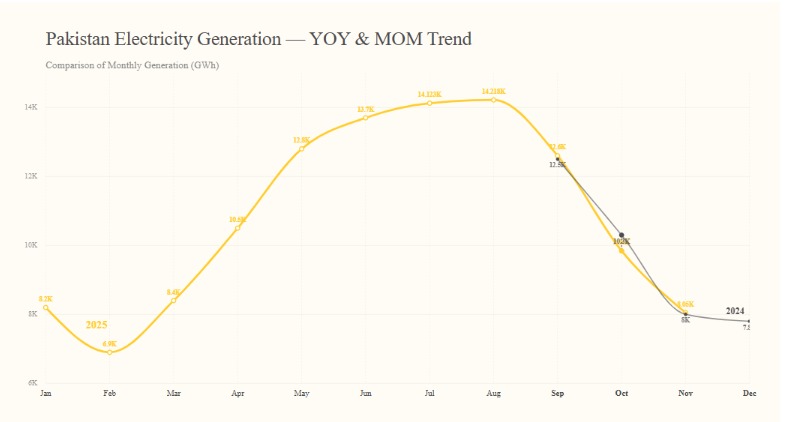
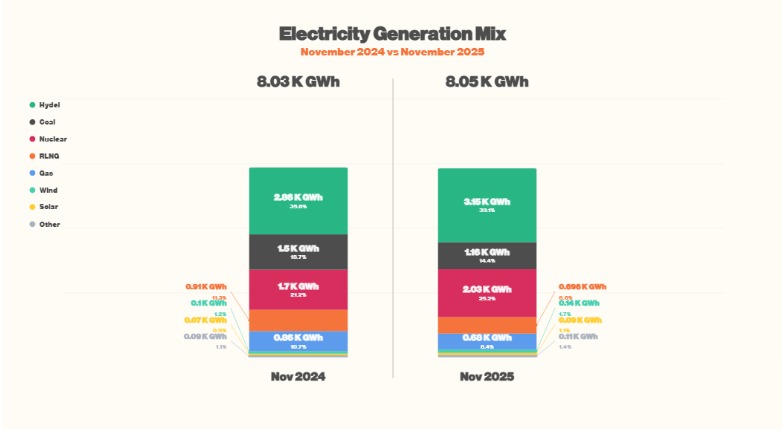
Pakistan’s power numbers for November follow a familiar seasonal pattern on the surface. Generation declined compared to October, costs eased, and hydel played a larger role. But taken together, the data also points to a deeper shift that continues to reshape the power sector.In November 2025, Pakistan generated 8,050 GWh of electricity. This was 18.6 percent lower than October and almost unchanged compared to November last year. Such month-to-month declines are typical as winter demand softens and generation patterns adjust.
Month-to-month movements are influenced by weather and seasonality, and November was no different. However, the year on year stagnation seen in November 2025 is especially concerning because it follows
The November generation mix provides important context. Hydel accounted for close to 40 percent of total generation, while nuclear output remained strong. Gas and RLNG were used less than in earlier months.
This reflects the normal operating logic of Pakistan’s power system. Electricity dispatch follows a merit order, where lower-cost sources are prioritized and higher-cost plants are brought in only when needed. As water availability improves, hydel output rises and reliance on expensive thermal fuels naturally declines..
The change in the fuel mix brought the average cost of electricity down. In November, the average cost was around 6.2 rupees per unit, compared to roughly 7.3 rupees per unit in November last year.
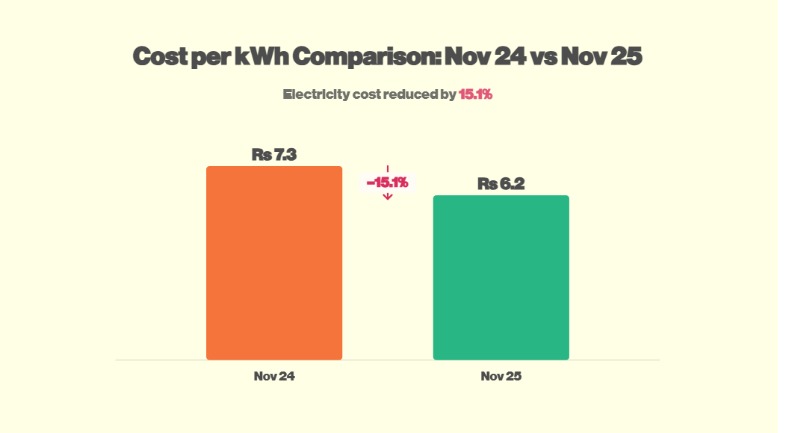
This reduction was driven primarily by dispatch decisions rather than fuel price changes. When cheaper sources make up a larger share of generation, overall costs tend to fall even if prices remain unchanged.
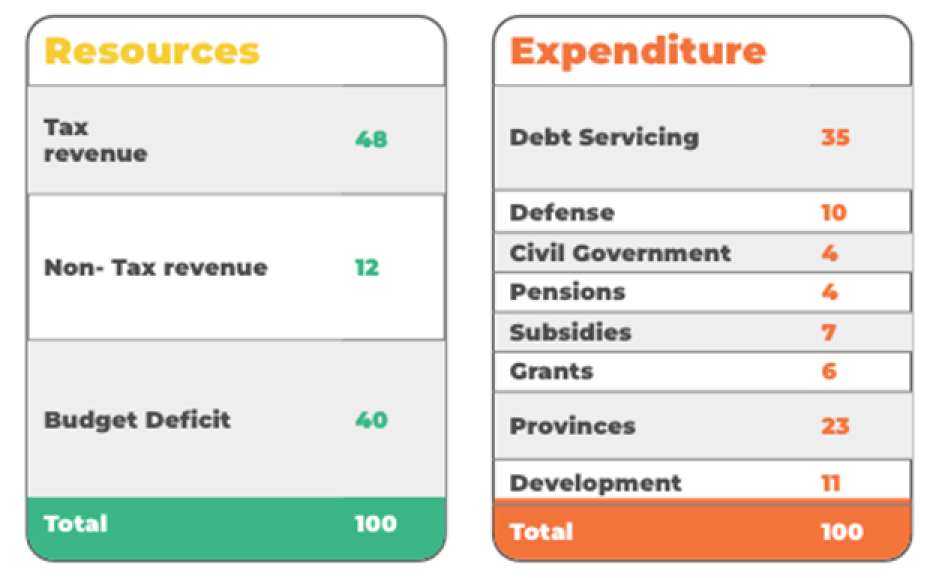
Since Pakistan consistently runs a budget deficit each year, it must take on additional debt annually to cover the shortfall.
Lower generation costs, however, do not resolve the broader financial pressures facing the power sector. Stress builds when there is a persistent gap between the cost of producing electricity and the amount recovered through billing and subsidies.
That gap feeds directly into circular debt.
In the first quarter of FY26, the monthly shortfall has been an estimated 25 billion rupees. One-time repayments can temporarily reduce the outstanding stock, but monthly deficits continue to accumulate as long as the underlying mismatch remains.
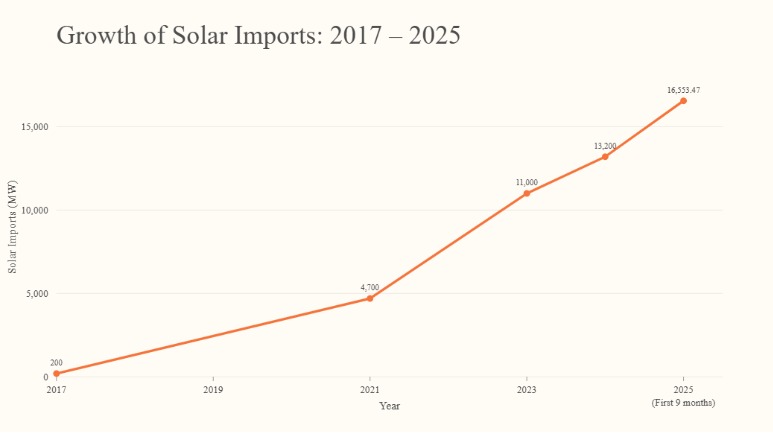
Beyond the grid, solar adoption continues to expand at a rapid pace. By September 2025, Pakistan had imported more than 16.5 GW of solar panels, reflecting several years of steady uptake across residential, commercial, and industrial users.
At the same time, battery imports have increased sharply, with battery imports in the first half of 2025 showing a 68% increase on 2024’s total numbers. Storage is increasingly becoming a standard component of new solar installations rather than an optional add-on. This is changing how electricity is consumed.
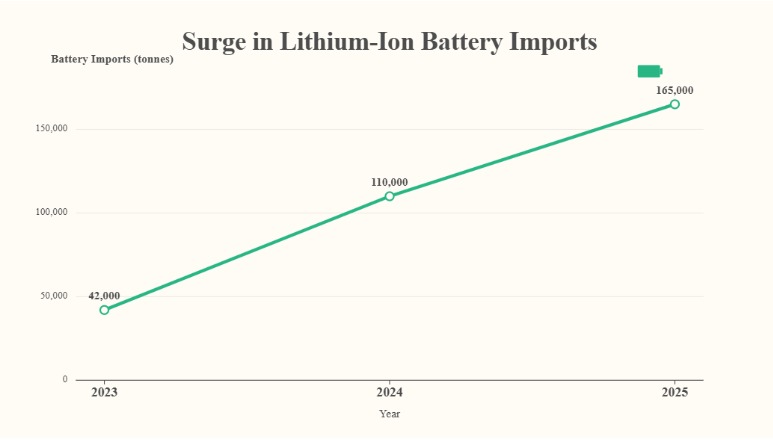
Power generated during the day can now be stored and used later. Dependence on the grid reduces during peak hours, and exposure to outages and tariff volatility becomes more manageable.
As these trends continue, Pakistan is effectively operating two power systems in parallel.
One is the national grid, built around centralized generation, fixed costs, and long-term contractual obligations. The other consists of distributed solar and battery systems owned and operated by consumers.
Costs remain concentrated within the grid, while a growing share of new demand is being met outside it. This structural shift is quietly reshaping Pakistan’s power sector, and the data is already beginning to reflect that reality.